



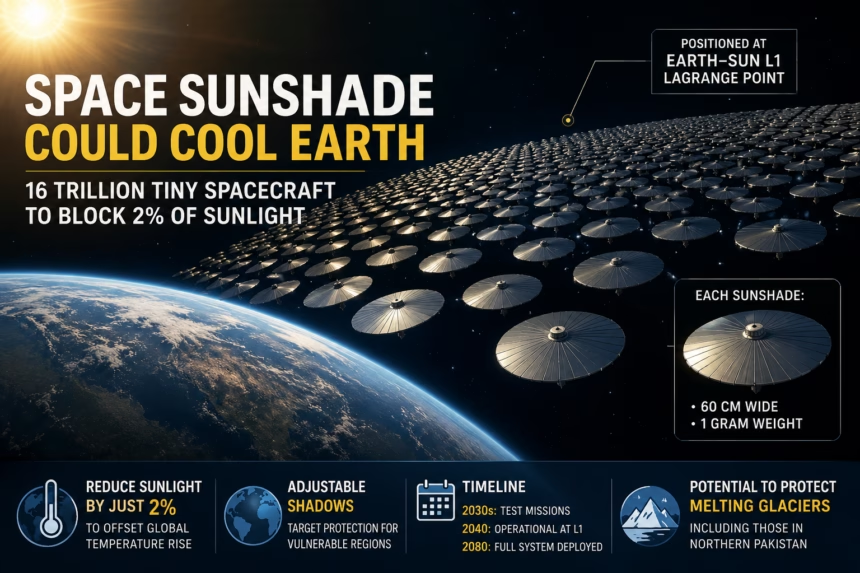
Scientists Propose Space Sunshade Swarm to Cool Earth by Blocking 2% of Sunlight
Space Sunshade is an ambitious climate engineering proposal designed to help cool Earth by placing trillions of ultra-lightweight spacecraft between the Sun and Earth. Scientists believe the Space Sunshade system could block around 2% of incoming sunlight, potentially offsetting some of the warming caused by greenhouse gas emissions.
Instead of building one enormous shield in space, the Space Sunshade concept envisions deploying around 16 trillion tiny spacecraft. Working together, these miniature sunshades would reduce the amount of sunlight reaching Earth by approximately 2%, which research suggests could help counteract much of the warming associated with rising atmospheric carbon dioxide levels.
Although the Space Sunshade remains in the research and development stage, scientists believe it could one day become part of a broader climate strategy if it proves technically, economically, and politically feasible. Experts also emphasize that a Space Sunshade would complement—not replace—efforts to reduce greenhouse gas emissions.
How the Space Sunshade Would Work
The concept was originally proposed by optical engineer Roger Angel, who suggested replacing the idea of one giant solar shield with a swarm of trillions of small, lightweight spacecraft.
Each spacecraft would:
- Measure roughly 60 centimeters in diameter.
- Weigh approximately one gram.
- Act as a miniature sunlight blocker.
- Work collectively with trillions of other units.
Instead of creating darkness, the system would only reduce sunlight by about 2%, allowing Earth’s climate to cool slightly while maintaining normal daylight conditions.
Positioned at the Earth-Sun L1 Point
The spacecraft would be placed near the Earth–Sun L1 Lagrange Point, a location where the gravitational forces of Earth and the Sun create a relatively stable position for spacecraft.
From this point, the swarm could intercept a small fraction of sunlight before it reaches Earth.
Could a 2% Reduction Make a Difference?
Climate models referenced by researchers suggest that reducing incoming sunlight by around 2% could counteract much of the warming associated with a doubling of atmospheric carbon dioxide levels.
Scientists emphasize that this would not remove carbon dioxide from the atmosphere. Instead, it would temporarily reduce the amount of solar energy reaching Earth, potentially lowering global temperatures while emissions reduction efforts continue.
Future Research: Movable Sunshades
Researchers, including Colin McInnes, have explored whether future versions of the technology could allow individual sunshade groups to move and redirect their shadows.
In theory, such a system might provide additional protection to regions especially vulnerable to heat, such as melting glaciers or areas experiencing extreme temperatures. However, this capability remains a research concept and has not been demonstrated.
Possible Timeline
Researchers have discussed a long-term development path that could include:
- 2030s: Early technology demonstration missions.
- Around 2040: Initial operational deployment near the Earth–Sun L1 point, if technical milestones are achieved.
- By 2080: A fully developed large-scale sunshade system, depending on future scientific progress, funding, and international cooperation.
These dates represent research projections rather than confirmed implementation plans.
Risks and Global Governance Challenges
While the technology could offer climate benefits, experts also warn of significant risks.
One concern is known as termination shock. If the world continued to emit large amounts of greenhouse gases while relying on a sunshade, and the system suddenly stopped operating due to technical failure, conflict, or another disruption, global temperatures could rise rapidly because the underlying greenhouse gas concentrations would remain high.
Another major issue involves governance. A system capable of influencing Earth’s climate would require unprecedented international cooperation to ensure that no single nation or organization could control its operation for political or strategic advantage.
Could It Help Protect Pakistan’s Glaciers?
Scientists have also explored whether targeted sunlight reduction could eventually help slow glacier melt in vulnerable mountain regions.
Countries such as Pakistan, home to thousands of glaciers in the Karakoram, Himalaya, and Hindu Kush mountain ranges, face increasing risks from glacier retreat and glacial lake outburst floods due to rising temperatures.
Although targeted regional shading remains theoretical, researchers believe future climate-engineering technologies could potentially complement existing adaptation strategies. Any such approach would require extensive scientific testing and international oversight before real-world deployment.
A Complement, Not a Replacement
Most climate scientists agree that technologies like a Space Sunshade should not be viewed as a substitute for reducing greenhouse gas emissions.
Instead, if proven safe and effective, they could become one tool among many—including renewable energy, energy efficiency, carbon removal, and conservation—to help limit the impacts of climate change.
As research continues, the Space Sunshade remains one of the most ambitious and debated proposals in the field of climate engineering.