



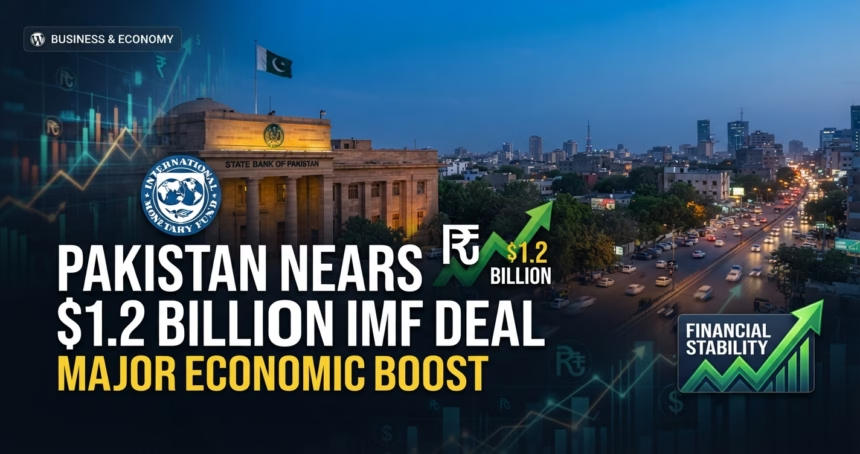
Islamabad: Pakistan IMF $1.2 billion talks have entered their final stage, with Pakistan and the International Monetary Fund (IMF) working to conclude the latest economic review. A successful agreement could pave the way for approximately $1.2 billion in fresh financing under Pakistan’s ongoing IMF programmes.
The latest talks cover Pakistan’s $7 billion Extended Fund Facility (EFF) and the $1.4 billion Resilience and Sustainability Facility (RSF). According to officials and people familiar with the discussions, the two sides are now working to finalise the Memorandum of Economic and Fiscal Policies (MEFP) after reaching agreement on most of the substantive issues.
The development comes at a critical time for Pakistan, as the government continues efforts to strengthen foreign exchange reserves, improve tax collection, control fiscal pressures and implement structural reforms under its IMF programme.
Pakistan IMF $1.2 billion disbursement talks have entered their final stage, with Pakistan and the International Monetary Fund (IMF) working to conclude the latest economic review.
IMF Talks Enter Final Stage
The IMF staff mission, led by Iva Petrova, has been conducting Pakistan’s fourth review under the Extended Fund Facility and third review under the Resilience and Sustainability Facility.
The mission began formal discussions in late September and has been reviewing Pakistan’s performance against economic and structural targets agreed under the IMF programme.
According to officials, negotiations have now entered their final phase. The two sides are expected to complete the MEFP, a key document that outlines the government’s economic policies and commitments under the programme.
If the review is successfully completed and a staff-level agreement is reached, the process could move towards IMF Executive Board consideration before the next tranche is released.
How Much Money Could Pakistan Receive?
The expected financing is approximately $1.2 billion from the two IMF programmes.
Pakistan’s current IMF arrangement includes:
- $7 billion Extended Fund Facility (EFF)
- $1.4 billion Resilience and Sustainability Facility (RSF)
Earlier reporting on the current review indicated that the expected financing could comprise roughly $1 billion under the EFF and about $200 million under the RSF. The exact amount and timing remain subject to completion of the review and subsequent IMF procedures.
The RSF is particularly important because it is designed to support countries facing longer-term vulnerabilities, including climate-related risks and the need for structural resilience.
Pakistan’s Tax Collection Provides Positive Signal
One of the more encouraging developments for Islamabad is the reported performance of tax collection during the first quarter of the fiscal year.
Sources cited in Pakistani media reports said the Federal Board of Revenue (FBR) exceeded the agreed first-quarter tax collection target.
The stronger revenue performance could help Pakistan demonstrate progress toward its fiscal commitments under the IMF programme.
However, the government still faces pressure to maintain revenue performance during the remainder of the fiscal year.
The IMF review is not simply focused on one quarter’s tax collection. The Fund is also examining broader fiscal reforms, expenditure management, energy-sector issues and structural benchmarks.
Foreign Exchange Reserves Under Review
Pakistan’s foreign exchange position is another important component of the discussions.
According to information reported during the latest talks, the State Bank of Pakistan briefed the IMF delegation on measures being taken to maintain foreign exchange reserves and manage inflationary pressures.
Dunya News reported that Pakistan’s foreign exchange reserves were around $21.4 billion, while commercial banks held an additional $5.4 billion, according to sources familiar with the discussions.
Maintaining adequate reserves is particularly important for Pakistan because the country has historically faced external financing pressures when import payments, debt servicing and other foreign currency requirements rise.
IMF Looking at Structural Reforms
While the immediate focus is on securing the next disbursement, Pakistan’s longer-term relationship with the IMF depends heavily on structural reforms.
The government has faced delays in meeting some structural benchmarks.
One issue discussed during the review concerns reforms to the Sovereign Wealth Fund Act and governance safeguards for certain state-owned enterprises.
Pakistan had also been required to implement reforms relating to procurement rules and other institutional measures under the IMF programme.
The government may seek waivers for some slippages, meaning the IMF could allow certain missed targets to be treated as exceptions if it is satisfied with Pakistan’s overall progress and corrective measures.
Energy Sector Remains a Major Challenge
Pakistan’s energy sector continues to represent one of the country’s biggest economic challenges.
The government is under pressure to address problems involving electricity subsidies, gas pricing, circular debt and the financial sustainability of energy-sector institutions.
Recent reporting indicates that the IMF is particularly interested in reforms to the subsidy system.
One proposed reform involves moving away from broad tariff-differential and cross-subsidy mechanisms toward more targeted assistance for low-income consumers.
Under the planned reform framework, electricity subsidies could increasingly be targeted toward eligible low-income households through the Benazir Income Support Programme (BISP) and the National Socio-Economic Registry (NSER).
Such reforms are politically sensitive because changes in electricity and gas pricing can directly affect household budgets and business operating costs.
Pakistan IMF $1.2 Billion Disbursement: What Happens Next
If approved, the expected IMF financing would provide an important boost to Pakistan’s external financing position.
The funds would not represent a complete solution to Pakistan’s economic challenges, but they could help strengthen confidence in the country’s economic management and reduce immediate pressure on external financing.
An IMF disbursement can also have a broader signalling effect.
Successful completion of an IMF review can improve investor confidence by indicating that Pakistan remains broadly on track with its agreed reform programme.
It can also make it easier for Pakistan to pursue additional financing from other international and bilateral sources.
Will the IMF Money Arrive Immediately?
Not necessarily.
This is an important distinction for readers.
Completion of negotiations does not automatically mean that $1.2 billion will immediately enter Pakistan’s foreign exchange reserves.
The current process involves several stages:
- Pakistan and the IMF complete the review.
- Both sides finalise the Memorandum of Economic and Fiscal Policies.
- IMF staff and Pakistan reach a staff-level agreement.
- The IMF’s Executive Board considers the review where required.
- Once the necessary approvals are completed, the relevant financing can be disbursed.
Therefore, headlines saying Pakistan has already “received” or “secured” the $1.2 billion would be premature at the current stage.
As of October 6, the more accurate description is that Pakistan is nearing an agreement that could unlock approximately $1.2 billion.
Why the IMF Programme Matters
Pakistan entered its current 37-month IMF programme after a period of severe economic pressure, including low foreign exchange reserves, high inflation, external financing concerns and fiscal imbalances.
The programme is intended to support economic stabilisation while requiring Pakistan to implement fiscal and structural reforms.
The IMF has already completed previous reviews under the programme.
In March 2026, the IMF announced a staff-level agreement covering the third review of Pakistan’s EFF arrangement and the second review under the RSF. The agreement contemplated approximately $1 billion under the EFF and $210 million under the RSF, subject to Executive Board approval, taking total disbursements under the two arrangements to about $4.5 billion at that stage.
The latest review therefore represents another important test of Pakistan’s ability to remain on track with the programme.
What Happens Next?
The immediate priority is for Pakistan and the IMF to complete the remaining discussions and finalise the MEFP.
If negotiations conclude successfully, the next major milestone will be the staff-level agreement and subsequent IMF approval process.
For Pakistan, the successful completion of the review would provide more than just fresh financing. It would also reinforce the government’s efforts to demonstrate fiscal discipline, improve revenue mobilisation and implement structural reforms.
However, the government will still need to address deeper economic problems, including the energy sector’s financial losses, high public debt, limited tax collection capacity and the country’s recurring external financing requirements.
Outlook for Pakistan’s Economy
The potential $1.2 billion IMF disbursement would provide some breathing room for Pakistan’s economy, but analysts and policymakers are likely to remain focused on whether the country can reduce its dependence on repeated external financing.
The key challenge is converting short-term stabilisation into sustainable economic growth.
That will require stronger exports, higher investment, improved productivity, broader tax collection, energy-sector reforms and greater private-sector participation.
For ordinary Pakistanis, the most important question will ultimately be whether economic stabilisation translates into lower inflation, greater employment opportunities, more stable energy prices and improved purchasing power.
For now, the completion of the IMF review would represent another important step in Pakistan’s economic stabilisation programme.
Conclusion
Pakistan and the IMF are in the final stage of negotiations that could pave the way for approximately $1.2 billion in additional financing under the country’s EFF and RSF programmes.
The talks are expected to conclude later this week, with the two sides finalising the Memorandum of Economic and Fiscal Policies.
While the potential disbursement would strengthen Pakistan’s external financing position and provide a positive signal to investors and international lenders, the money should not be considered approved or disbursed until the remaining IMF procedures are completed.
The bigger test for Pakistan will be whether it can use the current period of economic stability to implement reforms and build a more sustainable economy that requires less reliance on emergency external financing.
Published: October 6, 2026
Source: IMF, Pakistani government officials and reports from Pakistani media.